
For Display
-

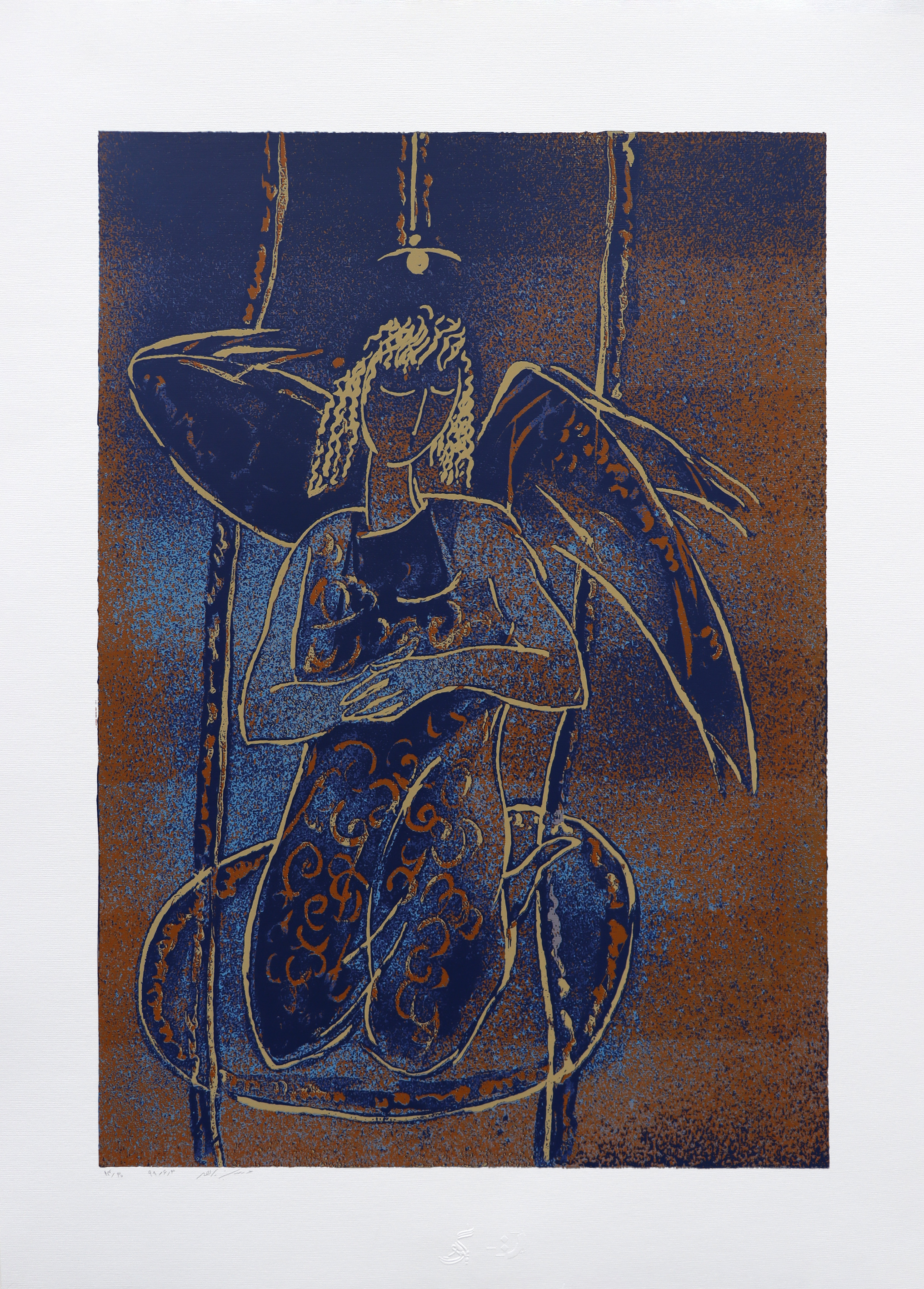
Mohamadhossein maher painter, sculptor, and art instructor, was born in the city of Abadan. From his teenage years, through his relative Mahmoud Dowlatabadi, he found his way into the studio of Shahab Mousavizadeh, where he received training in painting and drawing. In 1975, Maher entered the Faculty of Decorative Arts and pursued painting academically, studying under masters such as Hossein Kazemi, Mohammad Ebrahim Jafari, and Gholamhossein Nami. His social and political inclinations became evident during this period. For his thesis project, titled “Meeting in the Coal Mine,” he traveled to the coal mines of Zirab and Pabdana, where he stayed for a time and created drawings depicting the harsh working and living conditions of miners. After graduation, he was invited by the faculty to teach drawing from 1979 until the Cultural Revolution. With the outbreak of war, he was sent to Ahvaz as a soldier. His experience on the front lines, and the violence and destruction he witnessed, left a deep impression on him. In 1984, one year after his marriage, he and his wife, Parisa Sheibani, moved to France and enrolled at Paris 8 University. Alongside developing his painting skills, he studied Iranian art. In 1986, he left the university before completing his studies and returned to Iran. This marked the beginning of his extensive travels across different regions of Iran—especially the southern areas and the Persian Gulf coast. This nearly decade-long exploration became known as his “Southern Period” and earned him the title “Painter of the South.” Initially, this period reflected a return to his roots and an attempt to create indigenous art. Over time, however, local elements gave way to mythological archetypes, and by removing specific references to time and place, his work acquired a more universal quality. Maher did not limit himself to the outward forms of southern culture; instead, he sought deeper layers of meaning. He later reflected that what he painted was not exactly what he saw—there was always a distance shaped by climate, atmosphere, and lived experience. The harsh sunlight, humidity, movement of people, and even their physical features were influenced by the environment, yet translating these realities into painting required transformation rather than direct depiction. Until 1996, Maher held several group exhibitions featuring works from this period. From the mid-1990s onward, mythological and theological concepts—such as Mehr, Adam and Eve—began to appear in his work. With the addition of wings and increasingly angelic figures, his “Angels” period gradually took shape. The result of this period was exhibited in 2002 at the Iranian Artists Forum under the title “Embodiment in the Language of Drawing.” His next phase, known as the “Masks” series, was derived from the faces developed during the Southern Period. His interest in archetypes and mythology became more structured and explicit between 2007 and 2008, culminating in an exhibition at Asar Gallery in 2008. In these works, techniques such as removing facial features served as a bridge from the particular to the universal. In a later phase, Maher became fascinated with plant motifs and painterly qualities. However, this trajectory was interrupted by the events of 2009, which revived his social and political concerns. In the series “Shock,” he depicted bloody, butchered fish carcasses in a symbolic manner; these works were shown the same year at Etemad Gallery in Tehran. Continuing his engagement with social themes, he created the series “Monument,” focusing on migration and displacement, portraying wandering groups of people in desolate landscapes. His more recent series, “Stairs,” can be seen as a continuation of these concerns—melancholic compositions shaped by the interplay of stairs, walls, and lines that enter the frame through these elements.
Mohammad-Hossein Maher, born in 1957
Education: Tehran School of Decorative Arts (1975), Université Paris 8 (1984–1986, unfinished)
Teachers: Hossein Kazemi, Mohammad Ebrahim Jafari, Gholamhossein Nami
Professional background: Teaching drawing at the School of Decorative Arts (1979 until the Cultural Revolution), participation in the Iran–Iraq War
Artistic periods: Southern Period (1981–1996), Angels Period (mid-1990s), Mask Period (2000s), series including Shock, Monument, and Stairs
Exhibitions:
Solo exhibition, School of Fine Arts, Tehran (1980)
Solo exhibition, Seyhoun Gallery, Tehran (1986)
Solo exhibition, Seyhoun Gallery, Tehran (1988)
Solo exhibition, Seyhoun Gallery, Tehran (1990)
Solo exhibition, Art Hall, Rasht (1991)
Solo exhibition, Seyhoun Gallery, Tehran (1992)
Solo exhibition, Tehran (retrospective of works) (1993)
Solo exhibition, Bonn, Germany (1993)
Solo exhibition, Klassik Gallery, Isfahan (1994)
Solo exhibition, Seyhoun Gallery, Tehran (1994)
Solo exhibition, Cologne, Germany (1995)
Solo exhibition, Seyhoun Gallery, Tehran (1996)
Solo exhibition, Fereshteh Gallery, Tehran (1998)
Solo exhibition, Arya Gallery, Tehran (1999)
Solo exhibition, Gallery 13, Cologne (2001)
Solo exhibition, Iranian Artists Forum, “Drawing as Narrative” (2002)
Solo exhibition, Asar Gallery, Tehran (2008)
Solo exhibition, Etemad Gallery, “Shock”, Tehran (2009)
Solo exhibition, Etemad Gallery, Tehran (around 2011)
Solo exhibition, Iran Shahr Gallery, “Monument”, Tehran (2016)
Group exhibition, Kama Gallery, “Kama China Project”, Tehran (2019)
Group exhibition, Sarv Naz Gallery, “Eye of the City”, Shiraz (2019)
Group exhibition, “This/Here, That/There”, Tehran (2021)
Solo exhibition, This/Here Gallery, “That”, Tehran (2021)
Solo exhibition, Gallery +2, “Game”, Tehran (2023)
There is no data to display.