
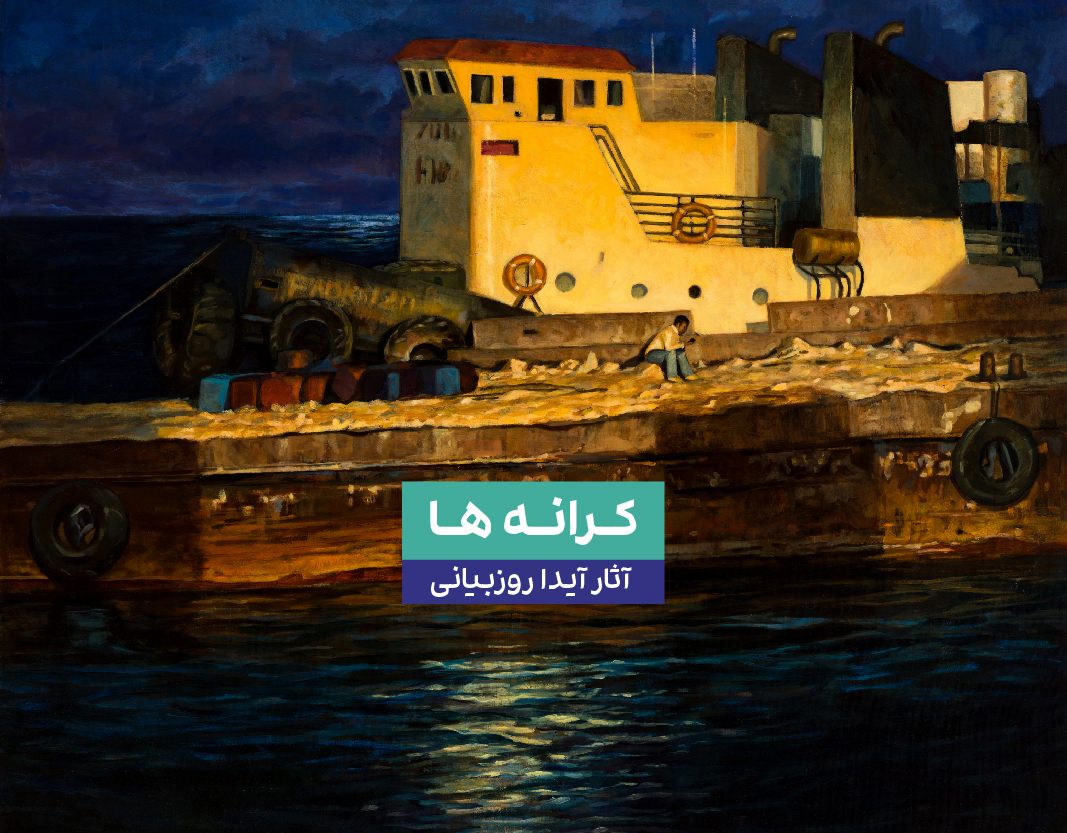

Ayda Roozbayani (b. 1995) is a Tehran-based figurative painter who holds a BA in painting from Alzahra University. She has mounted several solo exhibitions in Iran - for example, the 2023 show Suburb and her 2025 The Edges at Sarai Gallery - and gained wider attention with group shows (including the KHOR 2022 artists exhibition) and art fairs abroad. In 2024 she made her international debut at Untitled Art Miami Beach. Roozbayani works in oil, acrylic, watercolor, pencil and collage, merging classical and contemporary styles. Her subjects often fuse human figures with natural and industrial settings, exploring how modern life (and especially industrialization) affects people’s emotions and psyches. Water is a particularly important motif in her imagery, serving as a metaphor for mystery and introspection and often marking the boundary separating the figures from the rest of the world. Through these elements, Roozbayani conveys a collective feeling of confusion, solitude, and quiet anticipation in contemporary existence.

Roozbayani’s Edges series deepens her engagement with themes of isolation in modern life. This body of work examines solitude, estrangement, and adaptation in contemporary life. The paintings commonly depict lone figures or small groups who are physically together yet emotionally apart, suggesting how urbanization and technology can separate people. She captures a quiet instability of modern life, where characters feel detached from nature, community and even themselves.
The title Edges points to liminal boundaries, especially where land meets water. The artist grew up in coastal Chabahar and desert-border Zahedan, and for her the sea embodies memory and distance. In her words, “the sea is not scenery. It is memory, metaphor, border. It marks the edges of experience, the places where distance begins”. In these paintings “water appears…not to calm, but to trace the contours of absence and psychological distance,” and that “the ocean becomes a border: between places, between people, between past and present”. Thus water functions both as a literal setting and a symbol of separation and introspection in the works.

Roozbayani’s compositions unfold in suspended, in-between spaces. She describes them as “suspended moments in time, released into a wordless dialogue between things, between belonging and placelessness”. In other words, each scene balances on a threshold - the edges of memory and place. Her layered, photo-based landscapes exist “at the margins of experience, of geography, of self,” marking the “edges of inner and outer worlds”. This emphasis on margins reinforces the series title and the sense that the figures inhabit borderlands of both space and identity.

Rather than dramatizing crisis, Edges suggests subtle ongoing changes. The canvases do not show collapse, but faint signs of adaptation. Roozbayani’s paintings “suggest the subtler forms of transformation and survival,” offering a meditation on the emotional terrain of adaptation. This muted approach highlights the quiet, often unspoken ways people adjust to uncertainty. In sum, Edges meditates on how modern humans endure and evolve amid isolation and instability.
Visually, Roozbayani’s style is representational yet dreamlike. She paints in layered oil, often basing her scenes on photographs of real locations that she then transforms. Her compositions are “built through layers of oil paint…drawn from photographs of real locations, then subtly transformed into imagined landscapes where the boundaries of time and place begin to dissolve”. In The Edges 01, three casually dressed figures appear at a rocky shore beside a still, shallow pool. Their poses and spacing underscore detachment: one woman sits alone on a rock checking her phone, the other stands gazing into the water, and a man wades in the water looking down. None of them make eye contact or engage with each other.
The setting amplifies the theme of isolation. Towering ochre cliffs and boulders frame the scene, the bright sky overhead and the still, glassy pool create a serene but eerie calm. Roozbayani uses soft, natural light and earthy colors (golden rocks, greenish water, pale blue sky) that lend the image a suspended, timeless quality. Long shadows and gentle reflections emphasize the quiet stillness. In these works “everything is still, silent, and frozen, just as it was at the beginning of the world”. The composition itself feels static and contemplative, with every element poised between motion and pause. This careful staging of light and color, combined with the realistic rendering of figures, creates a palpable mood: one of introspection tinged with unease.
Technically, Roozbayani often centers her figures within landscapes in a way that blurs foreground and background. The imagery has a photographic clarity, yet there is also an intentional strangeness (for example, the clean lines of a concrete slab in the water or the near-ideal lighting) that make the scene feel like a memory or metaphor rather than a literal snapshot. The figures’ casual modern dress (shorts, sandals, smartphones) contrasts with the timeless rock setting, highlighting the tension between human life and the enduring landscape. Overall, the visual language of Edges - composed, almost static compositions; layered realism; and a palette of muted natural tones - consistently underscores the series’ themes of stillness, detachment and the spaces between worlds.

Roozbayani’s Edges can be read as a subtle commentary on contemporary Iranian and global realities. Geographically, her own background (from Iran’s southeast, near water and desert) informs her choice of environment. The solitary figures on a seaside rock may recall Iran’s vast coastlines or arid borderlands, places where the terrain itself is an “edge” between cultures or climates. More abstractly, the water and rocks symbolize the borders and divisions in life - between society and nature, technology and tradition, presence and absence. The artist has said that the sea in her paintings is a reminder “of absence, of separation, of the inner spaces we carry”, a perspective shaped by living in regions where literal borders are daily realities.
In a social sense, the paintings reflect the alienation of modern life. Each figure is alone in their world - one absorbed by a smartphone, another lost in thought - even as they stand inches from each other. This quiet solitude amid company suggests commentary on how technology and urban living isolate individuals. The fact that the setting is natural yet largely unpopulated can also imply humanity’s disconnection from the environment. Roozbayani’s scenes mirror “our contemporary alienation from nature, both external and internal”. The still, clean water at the figures’ feet contrasts with the arid landscape around, perhaps alluding to scarce water resources, an urgent issue in Iran’s climate. In this way the series speaks to environmental concerns (drought, desertification) without depicting them overtly.
Roozbayani’s approach is introspective rather than overtly political. Edges uses natural elements (water, land) to evoke memory and transformation. But Roozbayani focuses on the psychological edge: how individuals navigate an unstable world. The paintings’ “wordless dialogue…between belonging and placelessness” captures a universal unease about roots and identity. In the context of Iran - a country of diaspora and borders - the idea of floating between places carries extra weight. Yet the vision is also global. People of any culture can see in these quiet tableaux a reflection of modern disconnection and the yearning to belong.

Roozbayani explicitly blends art-historical styles. She merges classical and contemporary styles in her technique. While not directly citing specific mentors, her work suggests affinities with various traditions. The precise figure painting and subtle lighting recall realist and even Renaissance influences, whereas the dreamlike stillness has a modern, almost cinematic quality. In Iranian contemporary art, her focus on landscape and memory aligns with peers. Globally, one might loosely compare her moodiness to Edward Hopper’s lonely figures, though Roozbayani situates her vision in nature rather than urban interiors. Ultimately, her most direct reference is her own Iranian heritage. The way she infuses commonplace scenes with literary metaphor (water as border, land as psyche) feels akin to the narrative subtlety of Persian miniature painting, updated for the 21st century.
Ayda Roozbayani’s Edges series offers a haunting, introspective view of contemporary life. Through serene yet unsettling landscapes, she places her subjects on literal and metaphorical boundaries. The figures - isolated, silent, and poised at the water’s edge - embody the contradictions of modern existence: connected yet alone, grounded yet adrift. These painted moments mirror our contemporary alienation and quietly suggest how we adapt and survive amid uncertainty. Roozbayani’s mastery lies in the details: the gentle glow of sunlight, the reflective pool, the casual posture of a figure staring into her phone - all rendered in rich oil paint to create a scene that is at once specific and universal. The Edges ultimately leaves the viewer in that suspended, silent space between belonging and placelessness, prompting reflection on the subtle tensions at the margins of our own lives.
Hamidreza Karami