

Field and Circulation: Two Approaches to Understanding Artistic Value
To understand the difference between these two works, it is necessary to introduce two key theoretical frameworks that allow for an analysis of the relationship between art, society, and the circulation of meaning. The first is Pierre Bourdieu’s theory of the artistic field, which considers art not as an independent phenomenon, but as part of a “field” composed of social, economic, and institutional forces. From this perspective, artistic value does not emerge from the artwork itself, but from its position within the structure of cultural power. What legitimizes an artwork is a network of institutions, galleries, museums, and markets that recognize and validate it.
Alongside this perspective is Arjun Appadurai’s concept of the “social life of things,” which emphasizes the circulation and movement of objects across different cultural contexts. Within this framework, an artwork produces different meanings as it moves between places, audiences, and systems of value. Therefore, an artwork is not a fixed entity, but rather a changing process that is continuously redefined within each context. Combining these two perspectives makes it possible to analyze an artwork both as a “position within a field” and as an “object in circulation.”
Jeff Koons: The Rabbit Within the Global Field of Art Capitalism
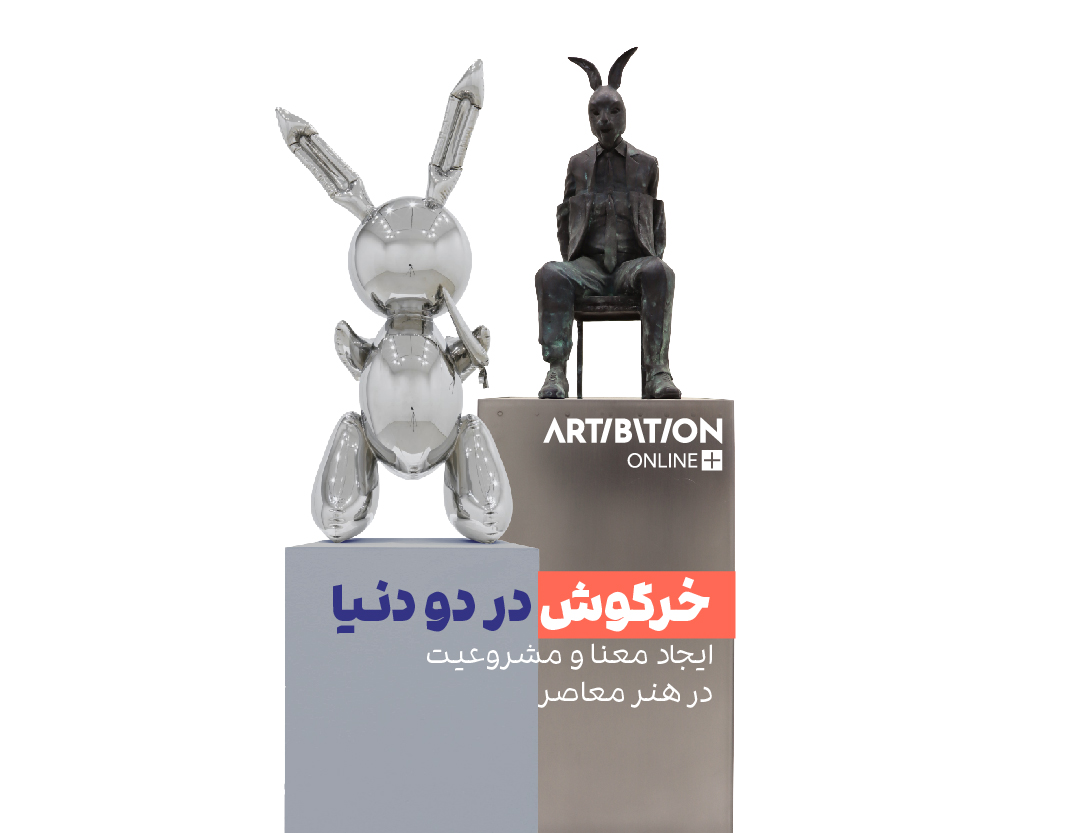
Koons’ Rabbit contains no sign of wounds, history, or a suffering body. Its mirrored surface and unified form create an experience of lightness and consumer-oriented visual pleasure. The work emerged during a specific historical moment in American art in the late 1980s, when the New York art market was increasingly shaped by capitalist logic. During this period, contemporary art gradually shifted from being a field of cultural production into an investable asset, and the artist came to be understood not only as a producer of meaning, but also as a “cultural brand.”
Jeff Koons operates within this context: a period in which galleries, auction houses, and private collectors were redefining the relationship between art and capital. His work does not exist at the margins of this system; rather, it is positioned precisely at its center. The choice of stainless steel, the mirrored surface, and the completely polished form directly respond to the logic of global circulation and market visibility. The artwork must function effectively within the gallery display, auction catalog, and media environment without losing its meaning.
Within this field, the artwork quickly enters a cycle of circulation: moving from gallery to private collection, from private collection to auction, and eventually reaching a level of “global symbolic capital.” Therefore, Koons’ Rabbit operates within an established system of value production—one in which seeing, recognition, and ownership function simultaneously. For this reason, it can be described as an “object for viewing,” because its meaning is primarily activated through visual experience, while the field itself has already guaranteed its significance.
Here, the artist’s responsibility is absorbed within the logic of the field. In other words, the artist participates in producing works that gain meaning through the structures of the market. Therefore, Koons’ work becomes part of the existing order of the global art field.
Nikzad Nojumi: The Rabbit Within the Diasporic Field and the Return to Context
Nojumi’s Rabbit presents a restrained, fragmented, and wounded body; a body not in a state of peace, but rather one positioned within tension, suspension, and pressure. Unlike Koons’ Rabbit, this work emerges from a different logic—one that must be understood in order to interpret both its form and its meaning.
An important point is that the work was produced in the United States but exhibited in Iran, where it entered a different cycle of meaning. This geographical movement itself becomes part of the production of meaning.
In his works, Nojumi engages with concepts of power, political history, and the controlled body. In the sculpture Rabbit, what we encounter is an animal figure transformed into a human-like form: a rabbit represented as a man in a suit, tied to a chair, with a body marked by fractures and cuts. These ruptures signify a body under pressure and suspended within a historical condition.
What distinguishes this work is the shift in its field of reception. The artwork is produced within the American context but is interpreted and experienced in Iran—where viewers encounter a network of historical and political meanings that are immediately recognizable. Unlike Koons’ Rabbit, Nojumi’s work does not submit to immediate visual consumption; it requires a reading that depends on the lived experiences of the audience.
The analysis of this work reveals a multilayered field that begins with production in one context and becomes activated in another. Therefore, Nojumi’s Rabbit is an artwork to be “read,” unlike Koons’ Rabbit, which is primarily an artwork to be “seen.” Its meaning does not exist solely within its form but emerges through the interaction between the artwork and its social context.
Here, the artist’s responsibility appears in creating a visual language for historical and political experiences, enabling a critical mode of interpretation. Therefore, the artistic legitimacy of the work lies in its ability to activate historical memory.
Two Rabbits, Two Systems of Value: Rethinking Artistic Legitimacy
Thus, Rabbit becomes an analytical case for understanding how meaning is produced within different fields of contemporary art. The central question of this article can be answered through this approach.
In the case of Jeff Koons, the simultaneity between the polished form of the artwork, the logic of the New York art market, and the institutional structure based on galleries and auctions causes meaning to operate primarily at the level of visual perception and to be absorbed into the cycles of consumption and institutional valuation.
In contrast, Nikzad Nojumi’s work, through the connection between diasporic experience, production in the United States, and interpretation within the Iranian art context, moves away from immediate visual consumption and reaches a level of historical-political reading and multilayered interpretation.
Ultimately, the difference between these two works does not arise from the sign itself, but from the interaction between form, field, and cultural circulation. In contemporary art, institutions, history, markets, and audiences simultaneously participate in the formation of meaning. From this perspective, the viewer also becomes part of the mechanism of meaning production.
In conclusion, the question remains: where do we stand within this mechanism? Are we positioned as those who confirm value, or as readers who activate meaning?
References
Bourdieu, Pierre. Distinction: A Social Critique of the Judgement of Taste. Translated by Hassan Chavoshian. Tehran: Ney Publishing.
Becker, Howard. Art Worlds. Translated by Hassan Khayati. Tehran: Ban Publishing.
Appadurai, Arjun (ed.). The Social Life of Things: Commodities in Cultural Perspective. Cambridge University Press, 1986.